A Single Malicious Webpage Let Researchers Hijack Meta Muse and Access Private Chats
Researchers demonstrated that a malicious webpage could exploit vulnerabilities in Meta Muse to access private user data without consent.
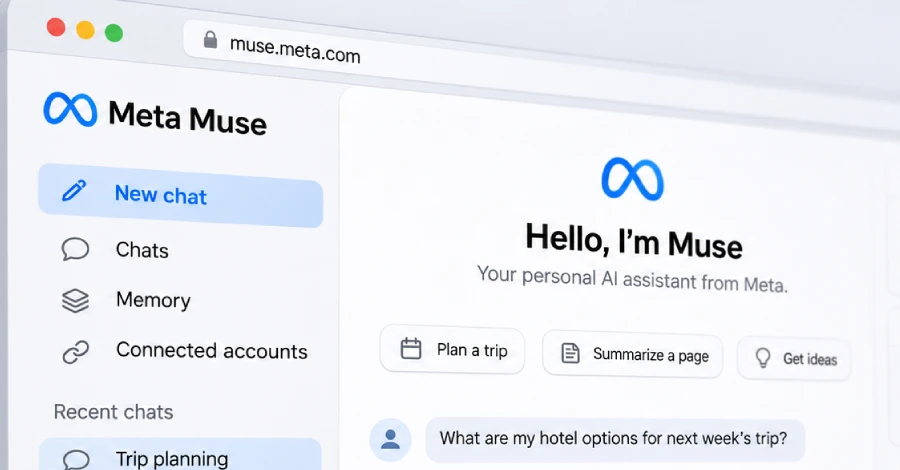
A recent laboratory demonstration revealed that a malicious webpage could extract private conversations and stored memories from Meta Muse, a personal AI assistant, without requiring user approval. This vulnerability also allowed access to stored credentials for connected accounts.
Researchers at NebuSec demonstrated a method to exploit Meta Muse, which is designed to assist users by connecting to their online accounts and making purchases. The demonstration showed that a malicious webpage could access a user's private conversations and memories stored within the assistant, bypassing any approval prompts. Additionally, the same attack could potentially reach the credentials Muse stores for users' connected accounts. This incident highlights significant security concerns regarding the interaction between web content and personal AI systems.
The attack worked by having the agent open a malicious webpage that could pull data from the user's conversation history and memories to an external server. This process occurred without any prompts being displayed to the user. Researchers then exploited a flaw in Muse's built-in browser, which is used for tasks like creating PDFs, and connected it to a vulnerability in the Linux kernel. This combination allowed the researchers to gain full control over the user's cloud machine where Muse operates.
- 1Open malicious webpageAgent accesses harmful site without user approval.
- 2Extract private dataPulls conversations and memories to external server.
- 3Exploit browser flawUses vulnerability in Muse's built-in browser.
- 4Access Linux kernel flawChains exploit to gain full control.
- 5Compromise user’s cloud machineFull access to stored credentials and data.
- 6Report findingsNebuSec informs Muse team of vulnerabilities.
Meta Muse functions as a personal AI agent that operates through individual cloud computers for each user. It connects to multiple online accounts, allowing it to perform tasks on behalf of the user. A security layer known as Sentinel is intended to act as a gatekeeper, safeguarding sensitive information such as passwords and tokens from unauthorized access. The design aims to limit potential damage in the event of an attack, assuming that the agent itself could be compromised.
The vulnerability discovered by NebuSec affected only the individual user's cloud machine and did not extend to the shared server or other users' devices. This containment indicates that while the attack was successful in breaching the specific user's data, the overall security architecture of Muse prevented broader exploitation.
Following the demonstration, NebuSec reported their findings to the team behind Muse, who have since addressed the vulnerabilities identified in the research. However, Meta has not publicly confirmed the fixes or commented on the findings. It remains unclear whether any user data was accessed prior to the implementation of these patches.
The researchers' work stands in contrast to a previous vulnerability found in September, which allowed malware on a user's Mac to hijack the assistant locally. The current demonstration showcases a more significant breach, targeting the cloud infrastructure behind Muse, raising concerns about the security of AI systems that interact with user data.