Linux KVM Flaw CVE-2026-99312 Lets Guest VMs Access Host Memory on AMD Hosts
A flaw in Linux KVM allows guest VMs on AMD hosts to access host memory, raising security concerns for cloud environments.
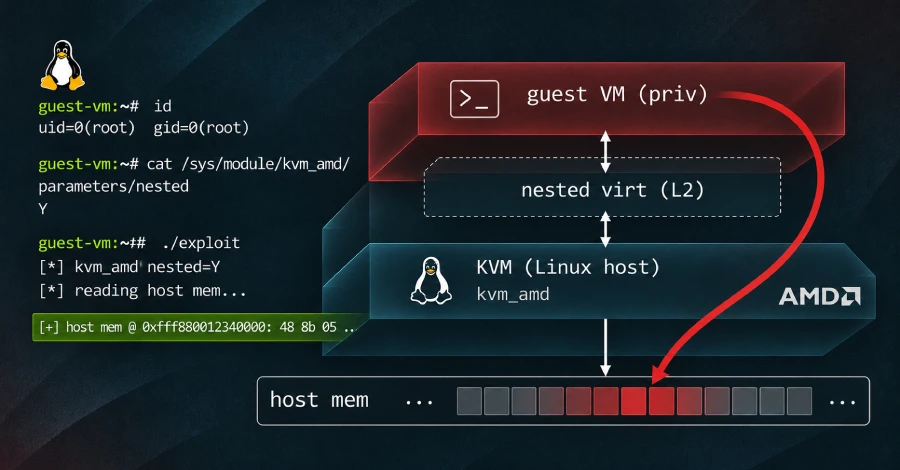
A vulnerability in the Linux Kernel-based Virtual Machine (KVM) has been identified, permitting guest virtual machines (VMs) on AMD processors to read host memory. This flaw, tracked as CVE-2026-99312, poses significant risks in shared cloud environments, potentially exposing sensitive data from other customers' VMs.
The vulnerability enables guest VMs to access approximately 127 GB of a cloud server's memory, which may include data from other customers' virtual machines. The issue affects only hosts equipped with AMD processors and where nested virtualization is enabled. This flaw was discovered by Oren Yomtov from Terra Security and was confirmed by the cloud provider, which treated it as critical.
The flaw operates through a mismanaged pointer in KVM's handling of nested virtualization. When a nested VM is reset, KVM neglects to restore the pointer to the outer VM's control block, leaving it directed at a page of memory that the kernel has already freed. This oversight allows a guest VM to manipulate the memory, potentially gaining access to sensitive data stored in the host's RAM.
KVM is a virtualization technology integrated into the Linux kernel that allows multiple virtual machines to run on a single physical server. Each VM operates in isolation, with its own allocated memory and resources. Nested virtualization enables a VM to host its own VMs, adding complexity to memory management. This technology is widely used in cloud computing, where multiple tenants share the same physical resources.
The vulnerability specifically impacts cloud service providers that utilize AMD processors with nested virtualization enabled, potentially affecting numerous customers. While the exact number of affected systems is unclear, the flaw's existence in shared environments raises concerns about data confidentiality and integrity. No reports indicate that the flaw has been exploited outside of research contexts.
The timeline of events shows that the flaw was reported through a bug bounty program, with the cloud provider confirming its existence on November 2, 2026. A fix was integrated into the upstream kernel on the same day, but it is still unknown when distribution kernels will receive the patch.
The cloud provider has implemented a live patch for its fleet, advising customers that no action is required on their part. However, operators of their own KVM hosts using AMD hardware are advised to update their host kernels or disable nested virtualization to mitigate the risk. The Linux kernel's CVE team has rated the flaw with a severity score of 8.8 out of 10, while Red Hat has assessed it as moderate.
Unknowns remain regarding the full scale of the vulnerability's impact, particularly how many cloud providers have enabled nested virtualization on their AMD hosts. Additionally, while the fix has been merged into the upstream kernel, the timeline for distribution kernels to be patched is still uncertain. Organizations should monitor this situation closely to ensure their systems are secure.
What security teams should do
- Update the host kernel to the latest version to apply the fix.
- Turn off nested virtualization on affected hosts if immediate patching is not possible.
What it meansA vulnerability allows guest VMs on AMD hosts to access host memory, risking data exposure in shared environments. Organizations need to address this flaw promptly to protect sensitive information.
Ask your IT team this weekWhich of our cloud environments use AMD processors with nested virtualization enabled?What is our timeline for patching affected systems?
DecisionThe IT team updates the host kernel to the latest version, and security checks that it was completed.