Researcher Demonstrates Database RCE Exploits Affecting PostgreSQL, MySQL and Oracle
A researcher has demonstrated remote code execution exploits affecting PostgreSQL, MySQL, and Oracle, highlighting vulnerabilities in low-privilege database accounts.
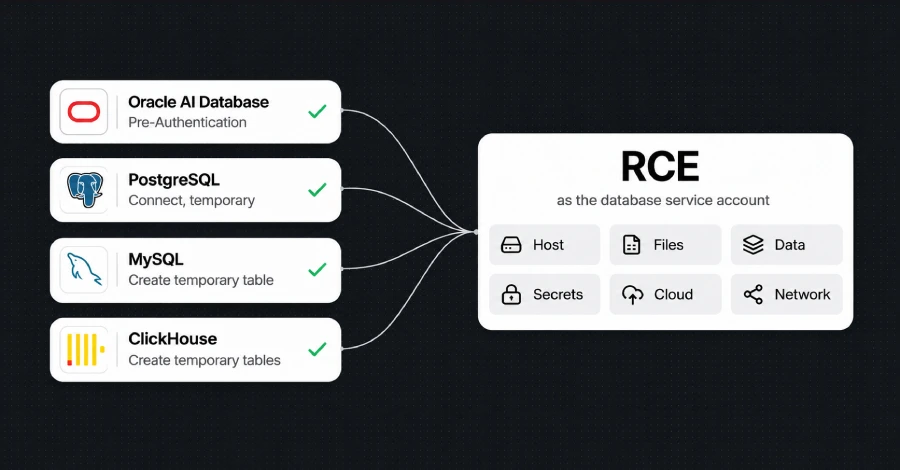
Zheng Yu, a researcher at Depthfirst, has shown that low-privilege database accounts can exploit memory-corruption bugs in PostgreSQL, MySQL, ClickHouse, and Oracle, allowing code execution on database servers. This finding raises concerns about the security of database systems and the permissions granted to accounts.
The researcher revealed that low-privilege database accounts, which typically lack the ability to read application tables, can still execute code on the database server itself. This is achieved by exploiting memory-corruption bugs in the database engine's underlying code. The exploits, published recently, serve as proofs of concept against PostgreSQL, MySQL, and ClickHouse, as well as a separate chain for Oracle that does not require a login. Importantly, none of these vulnerabilities have been observed in real-world attacks thus far.
The fundamental issue lies in the way SQL permissions are structured. While a database account's permissions dictate access to tables and schemas, they do not adequately restrict the execution of potentially unsafe C and C++ code used by the database engine. Common privileges, such as PostgreSQL's default TEMPORARY privilege or the ability to create temporary tables in MySQL and ClickHouse, provide enough leeway for an account to trigger these memory bugs.
Remote code execution (RCE) is a vulnerability that allows an attacker to run arbitrary code on a target machine or server. This can occur when a system inadvertently executes code supplied by an attacker, often due to flaws in the software or improper input validation. In this case, the researcher demonstrated how specific SQL permissions could be manipulated to exploit underlying vulnerabilities in database engines, leading to unauthorized code execution.
The vulnerabilities affect several database systems, including PostgreSQL, MySQL, ClickHouse, and Oracle. The researcher identified multiple flaws, with some already patched by their respective vendors. PostgreSQL's CVE-2026-116331 allows code execution as the operating system user for accounts that can create database objects. MySQL has a similar vulnerability in its query optimizer, identified as CVE-2026-101786. Oracle's case is notable because it allows exploitation without any login, leveraging bugs in Oracle Text and the GraphQL interface of Oracle REST Data Services.
The timeline of events began with the researcher's demonstrations, which highlighted the vulnerabilities. PostgreSQL issued a security advisory last week to address CVE-2026-116331, while Oracle patched CVE-2026-114819 and CVE-2026-91609 in its recent updates. ClickHouse also acknowledged a flaw reported through its bug bounty program, releasing a fix in early September.
In response to these findings, the vendors have released patches for the identified vulnerabilities. PostgreSQL and Oracle have provided documentation regarding their respective fixes, while ClickHouse has communicated the release of open-source fixes in version 26.9 and backported versions. Organizations are encouraged to review their database accounts and permissions to mitigate these risks further.
Unknowns remain regarding the full impact of these vulnerabilities in real-world scenarios, as there has been no evidence of active exploitation. Security teams should remain alert for any signs of attacks targeting these vulnerabilities and monitor for updates from vendors.
What security teams should do
- Organizations should update to the latest patched versions of PostgreSQL, MySQL, Oracle, and ClickHouse.
- Security teams should review and restrict database account permissions, particularly TEMPORARY privileges.
- Review what actions database accounts can perform, not just what data they can access.
What it meansA researcher has demonstrated how low-privilege database accounts can exploit vulnerabilities to execute remote code, which poses risks for organizations using these database systems.
Ask your IT team this weekWhat permissions do our database accounts have that could be exploited?Are all our database systems running the latest security updates?
DecisionThe IT team will review and tighten database account permissions, and security will verify the changes.