Trigram Campaign Impersonates About 50 AI and Blockchain Brands to Target Devs with Infostealers
The Trigram campaign is impersonating about 50 AI and blockchain brands to deploy infostealers targeting developers across Europe and the U.S.
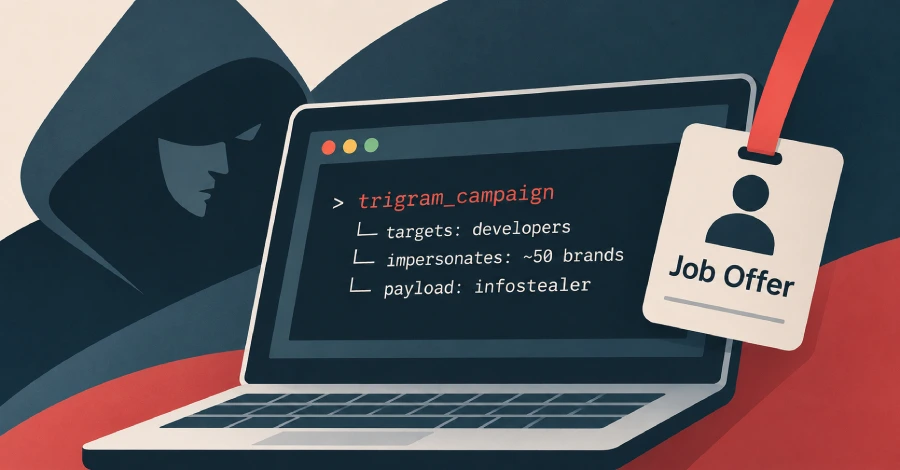
A large-scale campaign known as Trigram is impersonating approximately 50 brands in the artificial intelligence and blockchain sectors to trick developers into executing infostealers, according to a report from Stormshield. This activity highlights a sophisticated approach to cyber espionage, using social engineering tactics to infiltrate systems.
The Trigram campaign has emerged as a significant cybersecurity threat, targeting developers in the AI and blockchain sectors across Europe and the U.S. It employs various tactics, including impersonation of well-known brands, to deploy information stealers. Stormshield's report details how the campaign utilizes three social engineering scenarios—recruitment, conference invitations, and package tracking—combined with software supply-chain compromises and trojanized code repositories.
The attack chain is complex, involving multiple layers of deception. Developers receive phishing emails that appear to be legitimate job offers or requests to review code. Once they engage with the content, they inadvertently execute a malicious payload that installs the Overlord remote access trojan (RAT) on their systems. This RAT is designed to facilitate data theft, allowing attackers to harvest sensitive information.
At its core, the Trigram campaign leverages social engineering and malware distribution techniques. Social engineering involves manipulating individuals into divulging confidential information by exploiting their trust. In this case, attackers create fake scenarios that entice developers to interact with malicious content. The Overlord RAT, an open-source framework, enables remote access to compromised systems, allowing attackers to exfiltrate data.
The campaign has affected various sectors, particularly targeting developers in finance, cryptocurrency, education, and technology. Stormshield's report indicates that the scale of the operation is significant, given the number of brands impersonated and the complexity of the attack vectors employed. It is assessed to share similarities with intrusion sets linked to North Korea, specifically the Kimsuky group.
The timeline of the Trigram campaign began with its first observations in April and May 2026, with phishing emails targeting developers. The activity has evolved, with recent reports indicating that the campaign has expanded its focus to include Ukrainian experts in diplomacy and security. This indicates a shift in the campaign's targeting strategy, aiming to gather intelligence on geopolitical matters.
Stormshield has consolidated findings from various cybersecurity firms, linking them to the Trigram campaign. The report outlines the tools and methods used, including a management platform and victim-tracking consoles. The attack sequence is designed to adapt to different environments, making it a versatile threat for organizations.
Unknowns surrounding the campaign include the full extent of its impact and whether additional sectors may be at risk. While the report provides a comprehensive overview of the tactics employed, the long-term implications for the affected sectors remain uncertain. Security teams should monitor developments closely as more information becomes available.
As organizations continue to address the Trigram threat, it is crucial to implement robust security measures. This includes educating employees about the risks associated with social engineering and regularly updating security protocols to mitigate potential vulnerabilities.