Cursor Says Stolen Fireworks AI Key Led to Trojanized Claude Code Extension Incident
Cursor has confirmed a data breach exposing 5,000 users.
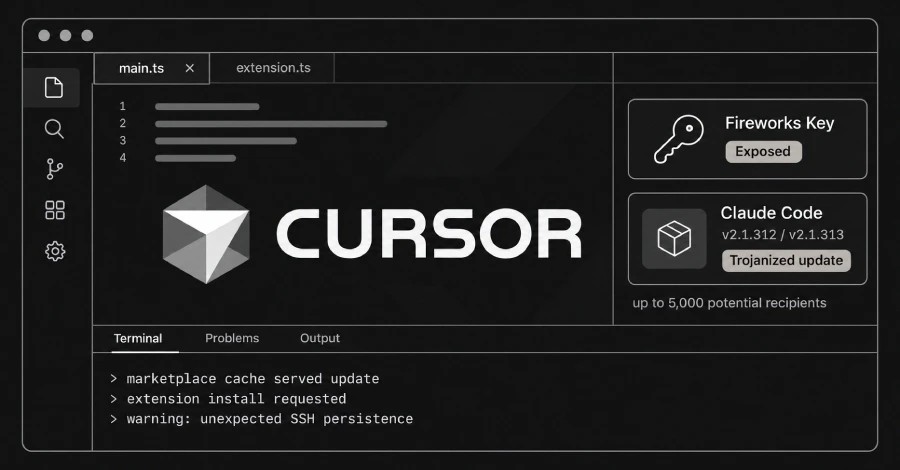
Cursor has confirmed a data breach exposing 5,000 users.
The compromise of Anthropic's official Claude Code extension on Cursor's extension marketplace was the result of the theft of an access key that was exposed in the wake of a breach targeting Fireworks AI.
The disclosure comes nearly two weeks after a trojanized version of Anthropic's official Claude Code extension was distributed through Cursor Marketplace as a legitimate update, attempting to install a persistent SSH backdoor on affected systems.
The attacker, Cursor added, used these credentials as a starting point to reach select software-as-a-service (SaaS) tools used by Cursor and then access the following data - Cursor said it took steps to deactivate the vendor's key, revoke and rotate credentials, and hunt for signs of deeper access, and contain it after
The development comes as Uber confirmed unknown threat actors stole thousands of drivers' license information after obtaining internal credentials.
Although the name of the provider was not disclosed, TechCrunch reported that the provider in question is Fireworks AI.
Anyone whose data Cursor held is potentially affected by this breach.
Privacy Mode is a Cursor-specific setting that, if enabled, allows users to opt out of their data being used for training purposes.
Among these traces were credentials that had not been edited out, exposing the API credentials of less than 0.01% of customers in the process.
The access point here was stolen login credentials, not a technical vulnerability.
The company said it notified affected users who installed versions 2.1.312 or 2.1.313 from the marketplace during the exposure window and helped revoke exposed credentials.
Cursor has notified affected individuals about the breach.
There is no evidence that the incident impacted users who had enabled Privacy Mode, customer code repositories, Cursor's own production environment, Cursor app and its official updates, its other apps, or any other extension or plugin downloaded from Cursor Marketplace.
Why it matters
Beyond the immediate exposure, Cursor now has to rebuild trust with everyone whose data it held.
The company also said it temporarily disabled internal and product services, disrupting access to some Cursor features.
The next phase of the attack took place on October 29, 2026, when the attacker used a stolen credential from the exposed data of its internal system to place trojanized versions of Anthropic's Claude Code extension directly on the cache used to serve Cursor's extension marketplace.
What security teams should do
- If you have any relationship with Cursor, watch for phishing attempts that reference this breach specifically -- stolen data often gets reused this way.