eMudhra Revokes 8 More CAs It Previously Declared Unaffected by Key Compromise
The in-house Python script behind eMudhra's October key compromise has now cost the company 8 more of its intermediate certificate authorities (CAs), even though it did not weaken their keys.
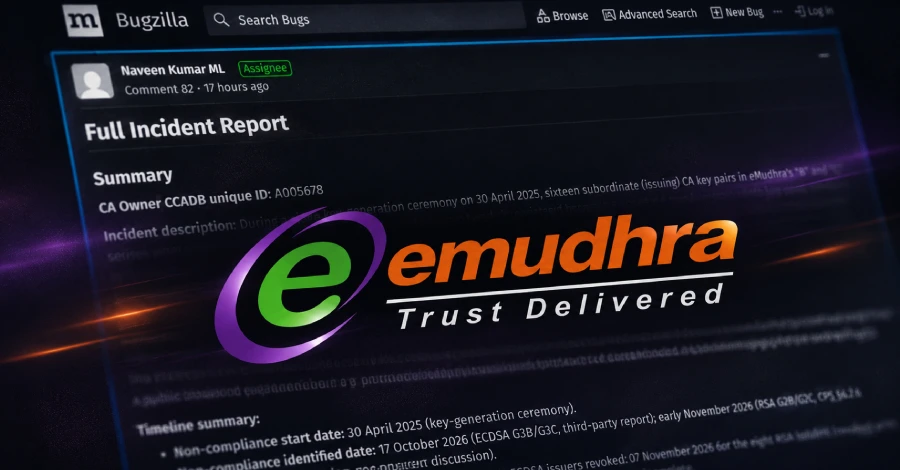
The in-house Python script behind eMudhra's October key compromise has now cost the company 8 more of its intermediate certificate authorities (CAs), even though it did not weaken their keys.
Each intermediate CA has its own private key, which the company uses to sign the certificates it issues.
The 8 intermediate CAs compromised in October had a different problem: a single line in the script cut each of their keys to one byte, the company said this week.
The script also retrieved the RSA keys of the 8 newly revoked CAs from the company's hardware security modules (HSMs).
Both problems began at a key ceremony on April 30, 2025, according to the full incident report the company posted to the same bug tracker this week.
The Hacker News worked out all 8 keys from their public certificates.
Of the 8, 6 were for website (TLS) certificates and 2 for code signing; the keys were meant for Crypto4A HSMs at the company's US and EU sites.
The rebuilt key carried a label almost identical to the original's, which allowed the weak copy to be sent for signing and certification, and the company reached that view in early November, after discussions with browser root programs.
Logs and files from that computer cannot reliably show how the material was handled.
Microsoft will start removing the 10 remaining eMudhra roots, including emSign Root CA - G1, on November 16, according to an update to its security response post earlier this week.
Nothing in the ceremony tested the key's strength or checked the certified key against the first generated key, and the company fixed them at the time by re-signing the lists with the keys that matched the certificates, which were the weak ones.
The script did not shorten those keys, and every signature still checks against the certified key; kPMG, which the company hired as an independent reviewer, is due to finish by December 4.
What happened
The in-house Python script behind eMudhra's October key compromise has now cost the company 8 more of its intermediate certificate authorities (CAs), even though it did not weaken their keys.
Each intermediate CA has its own private key, which the company uses to sign the certificates it issues.
The 8 intermediate CAs compromised in October had a different problem: a single line in the script cut each of their keys to one byte, the company said this week.
What changed
The script also retrieved the RSA keys of the 8 newly revoked CAs from the company's hardware security modules (HSMs).
Both problems began at a key ceremony on April 30, 2025, according to the full incident report the company posted to the same bug tracker this week.
The Hacker News worked out all 8 keys from their public certificates.
Who is affected
Of the 8, 6 were for website (TLS) certificates and 2 for code signing; the keys were meant for Crypto4A HSMs at the company's US and EU sites.
Why it matters
The rebuilt key carried a label almost identical to the original's, which allowed the weak copy to be sent for signing and certification, and the company reached that view in early November, after discussions with browser root programs.
Technical details
Logs and files from that computer cannot reliably show how the material was handled.
Microsoft will start removing the 10 remaining eMudhra roots, including emSign Root CA - G1, on November 16, according to an update to its security response post earlier this week.
Response
Nothing in the ceremony tested the key's strength or checked the certified key against the first generated key, and the company fixed them at the time by re-signing the lists with the keys that matched the certificates, which were the weak ones.
What remains unknown
Whether anyone used the keys against software that skips that check is not known.
What to watch next
Watch for revised vendor guidance, fixed versions and mitigation updates.