Jensen Huang's Resignation Is an Insider-Threat Story, Not Just a Leadership One
Nvidia's CEO resigned this week after reports of an affair with a woman under FBI investigation for suspected ties to Chinese intelligence. Here's what's actually confirmed, what isn't, and the real security lesson for anyone running a strategically critical company.
Jensen Huang resigned as Nvidia's CEO this week. If you've only seen the headlines, you've probably seen it framed as a personal scandal — an affair, a resignation, a company moving on. I want to walk through what's actually confirmed, what's still just reported, and why I think this is one of the more important insider-threat stories of the year, not a tabloid one.

Jensen Huang, photographed at Stanford, April 2026. Photo: Anderseidesvik, CC BY-SA 4.0, via Wikimedia Commons.
What's actually confirmed
Nvidia's own SEC filing is the anchor fact here, and it's unambiguous: Huang resigned, the board appointed CFO Colette Kress as interim CEO, and a search for a permanent CEO is underway. That's not reported-by-anonymous-sources territory — that's a company telling the market, in a legal filing, what happened. Nvidia reports its next quarterly earnings on 17 November, and you can bet every analyst question on that call will be about this.
What's reported, and how carefully you should hold it
Everything past the resignation itself sits at a lower confidence level, and I think it's worth being explicit about that rather than letting it blur together the way most coverage has.
The New York Times first reported that Huang had admitted to a relationship with a woman identified as Alice Huang (no relation — the shared surname is coincidental), and that US intelligence officials have been looking at her over suspected ties to Chinese intelligence. CNN's own sourcing is the most careful on this point, and it matters: the intelligence collected on her so far does not prove she was acting as an agent for Beijing. NBC reports her precise role, if any, is still unclear. The FBI has reportedly been investigating the relationship for about a year, and Nvidia's board is reportedly investigating separately whether Huang was the target of a foreign intelligence approach.
Separately, NYT and CNN have reported a second alleged relationship, with an Nvidia vice president who pulled out of a scheduled industry appearance after the reports broke. Reuters has reported a third, with sources differing on the details. None of this has been publicly confirmed by the people named in it, and I'm deliberately not treating it as settled fact here — it's reported, not established.
So: one confirmed resignation, and a cluster of serious but still-unproven allegations under active investigation. Both things can be true at once, and conflating them — either by repeating the spy allegation as fact, or by waving the whole story off as "just tabloid stuff" — gets the real lesson wrong either way.
Why this is a security story, not just a leadership one
Nvidia doesn't make a consumer product you can swap out if you don't trust the company behind it. Its chips are the substrate nearly every major AI system in the world runs on, and the company sits directly inside US export-control policy toward China. That's exactly the kind of position — a person with singular influence over a company that sits at the center of national technology and security policy — that makes someone a genuinely attractive target for a foreign intelligence service, whether or not this specific relationship turns out to be one.
This is, in plain terms, the insider-threat scenario every counterintelligence briefing warns about: proximity, trust, and leverage, built slowly over time, around someone who has no reason to think of themselves as a target. It doesn't require Huang to have done anything wrong, and it doesn't require Alice Huang to be proven an agent, for the exposure itself to be real. An intelligence service doesn't need a confirmed asset to get value out of a relationship with the right person — sustained personal access to someone with that level of strategic importance is useful on its own, proof of tasking or not.
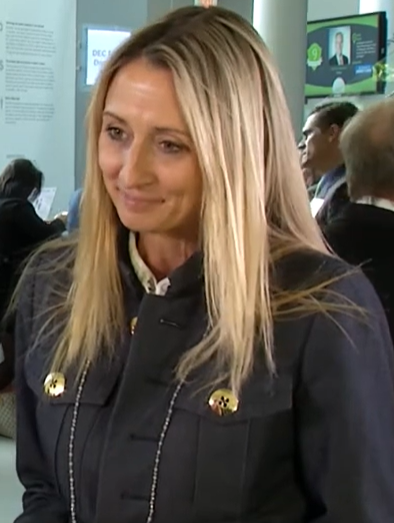
Colette Kress, Nvidia's CFO, now serving as interim CEO. Photo: SiliconANGLE theCUBE, CC BY 3.0, via Wikimedia Commons.
What I'd actually take from this if I were advising a board
A few things, and none of them are "fire your CEO the moment a rumor appears":
Executive-level counterintelligence briefings aren't just for defense contractors anymore. If your company sits inside export controls, critical-infrastructure supply chains, or anything a nation-state would consider strategically important, your most senior people are plausible targets for exactly this kind of long-game approach — not just phishing or malware aimed at your network.
Treat "unproven" and "irrelevant" as different categories. CNN's reporting that the intelligence doesn't prove she was an agent is the right level of caution for a newsroom. It is not the right level of caution for a board deciding whether to investigate. Boards get to — and should — act on risk exposure well before something is legally proven, while still being honest with employees, investors and the public about what is and isn't confirmed.
No company should have a single point of failure at the top. Nvidia had a CFO ready to step in as interim CEO within what appears to be days of the board acting. That's succession planning working as intended. If your organization couldn't name who takes over tomorrow if your CEO had to leave without notice, that's the actual, fixable gap this story should make you check.
The technology here was never the problem. The problem — if there turns out to be one — was always going to be a person with real access, real influence, and a relationship nobody outside a very small circle knew enough about until it was already a resignation.
- Insider Threat
- National Security
- Leadership
 Written by Deepak Kumar, CISSPEnterprise security leader, 20 years — Full profile →← Back to Blog